OpenAI has integrated an artificial intelligence-powered search engine into ChatGPT, the company announced Thursday, a move that could enter OpenAI into an internet search market dominated by Google.
Key facts
A search feature was enabled for paying ChatGPT Plus and ChatGPT Team users Thursday, and the new feature will be rolled out to those using the free version of the chatbot “over the coming months,” according to OpenAI.
The search engine was tested among a group of about 10,000 users and some publishers in July as a separate product, SearchGPT, which OpenAI said would utilize the company’s AI models to provide search results.
ChatGPT’s new search engine summarizes information from websites and then provides short descriptions with an attribution link instead of linking directly to a website, and allows users to ask follow-up questions or open other relevant links in a sidebar.
In one example, searching for musical festivals in Boone, North Carolina, in August results in a list of each festival and a short description, followed by a link to a website for that festival, with a sidebar with links to other relevant results like event scheduling or ticket sales.
OpenAI previously said publishers will be able to “manage how they appear” in search results and can opt out of having their content used to train OpenAI’s models while still appearing in searches.
Key background
There has been speculation on a new search engine from OpenAI this year, as the company moves to compete with Google in the search market. Bloomberg reported in May—citing a person familiar with the matter—that OpenAI was developing a new search feature for ChatGPT intended to compete with Google and the AI search startup Perplexity. At the time, OpenAI was “aggressively trying to poach Google employees” to develop the product, according to The Verge. OpenAI was reportedly planning the new search engine in May, before Google announced plans for its Gemini AI products at the company’s annual developer conference. OpenAI has partnered with several publishers over the last year, including the Associated Press, the Financial Times, The Wall Street Journal parent News Corp, and Politico and Business Insider’s parent company Axel Springer, among others. The partnerships allow OpenAI to use content by each publisher to help answer user queries and train the company’s AI models.
Tangent
The New York Times filed a lawsuit against OpenAI and Microsoft in December alleging “unlawful use” of millions of copyrighted articles by the publisher being used to train AI models. The Times alleges OpenAI and Microsoft’s technology that powers ChatGPT and Bing Chat, now called Copilot, could “Generate output that recites Times content verbatim, closely summarizes it and mimics its expressive style.” OpenAI filed a motion to dismiss parts of the complaint, suggesting users did not use ChatGPT or other products from the company as a “substitute” for a subscription to the Times. The lawsuit is ongoing.
Gold bullion bar on dark background. Large cast investment gold ingot. Swiss gold. Business and finance.
The UAE central bank’s gold reserves increased by 5.3% month-on-month to reach $6.3 billion (AED 23.19 billion) by the end of the third quarter of 2024, up from $6 billion (AED 22.02 billion) in August.
Gold reserves
The Gulf state’sgold reserves had grown by over 27.8%, or $1.36 billion (AED 5 billion) since the start of 2024, from $4.94 billion (AED 18.15 billion) by the end of last year, state-run Emirates News Agency (WAM) reported on Wednesday, citing the monthly statistical bulletin released by the Central Bank of the UAE (CBUAE).
The UAE had ninth place among Arab countries in terms of gold reserves, with 75 tons of gold reserves, constituting 2.8% of the central bank’s total reserves, according to a World Gold Council report in August.
Meanwhile, the central bank said that demand deposits in the country rose by over 3% to $290 billion (AED 1.08 trillion) by the end of September, which included $212.78 billion (AED 781.53 billion) in local currency.
The country’s banking sector has witnessed a significant rise in deposits, with savings deposits reaching $82.91 billion (AED304.53 billion), according to the WAM report.
Of this, about $69.86 billion (AED256.6 billion) is in the local currency. Furthermore, time deposits have touched $241.89 (AED 888.47 billion) by the end of September, with around $147.73 billion (AED 542.6 billion) in local currency.
Also, the net international reserves of the UAE banking sector reached $360 billion (AED1.32 trillion) at the end of September, registering a 15% year-to-date rise from $310 billion (AED 1.15 trillion) by the end of December 2023.
Besides, the value of cash withdrawals from the central bank in the first nine months of 2024 reached about $41.37 billion (AED151.97 billion), while cash deposits with the central bank amounted to around $38.34 billion (AED140.83 billion), the WAM report added.
Big numbers
$3.9 trillion (AED 14.34 trillion): That’s the total transactions in the banking sector in the country via the UAE Fund Transfer System (UAEFTS) in the first nine months of this year, Of this, more than $266.75 billion (AED 979.77 billion) were the value of circulated checks, based on their e-images.
“Today we’re excited to launch our next era of models built for this new agentic era: introducing Gemini 2.0, our most capable model yet,” Alphabet CEO Sundar Pichai said while launching Gemini 2.0.
“With new advances in multimodality — like native image and audio output — and native tool use, it will enable us to build new AI agents that bring us closer to our vision of a universal assistant,” he added.
The Gemini 2.0 is preceded by the Gemini 1.0, unveiled in December 2023, and the Gemini 1.5.
Google’s latest AI model was born from its investments in developing newer agentic models, capable of understanding more about the human world, thinking several steps forward, and taking decisions and actions on a user’s behalf under their supervision.
The Gemini 2.0 is currently being given to developers and trusted testers for use, said the US-based tech giant.
It is also on the fast track to getting integrated into Google’s products, starting with its generative AI chatbot Gemni and its widely-used search engine product Search.
Google added that it will be unveiling a new feature, Deep Research, which employs highly progressed reasoning and long-context capacities to fulfill the duties of a research assistant.
Deep Research will be capable of studying complicated subject matters and putting together reports on a user’s behalf. It was made accessible to users via Gemini Advanced on Wednesday, said Pichai in his statement.
The company has plans to introduce Gemini 2.0’s sophisticated reasoning abilities to its AI Overviews, which now reach one billion people. This will help Google’s AI Overviews to handle more advanced topics and multi-step queries, such as complex math equations, multimodal questions, and coding.
It has already begun limit testing Gemini’s incorporation into AI Overviews this week and will be unraveling it at a much larger scale during the start of 2025, while working to increase geographical and lingual access to AI Overviews throughout the rest of the coming year.
Share price
Shares of Alphabet, the parent company of Google, rose 0.8% $196.97 in after-hours trading on December 11, 2024, giving it a market capitalization of $2.4 trillion.
Net worths
Its co-founder and board member Larry Page ranks sixth on Forbes’ The World’s Real-Time Billionaires list with a net worth of $160.8 billion as of December 12, 2024. Also, cofounder Sergey Brin ranks seventh with a net worth of $153.5 billion as of the same day. Alphabet ranks 10th on Forbes’ 2024 Global 2000 list.
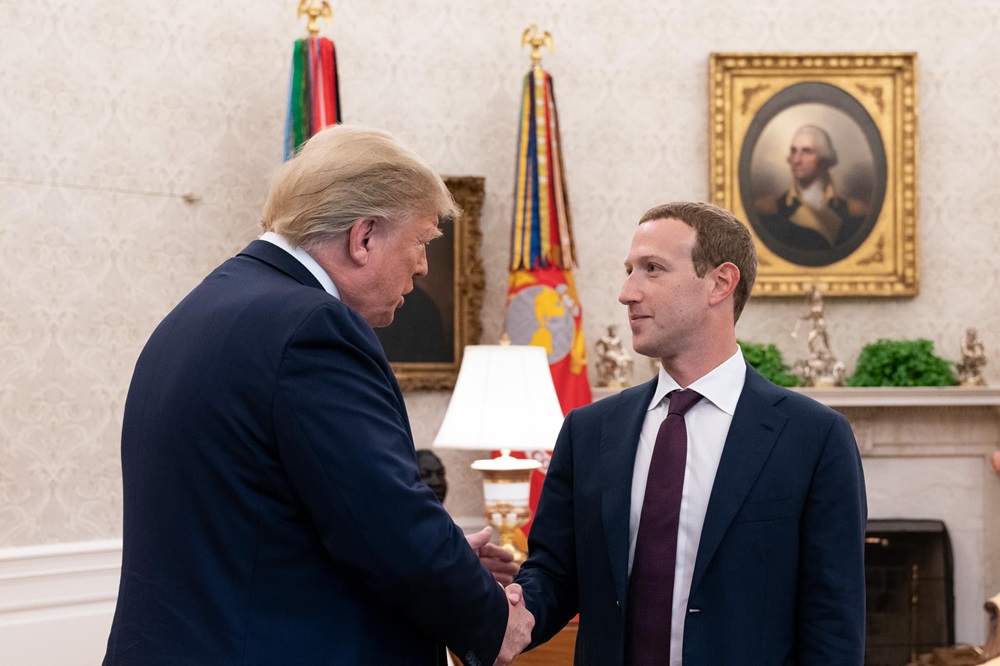
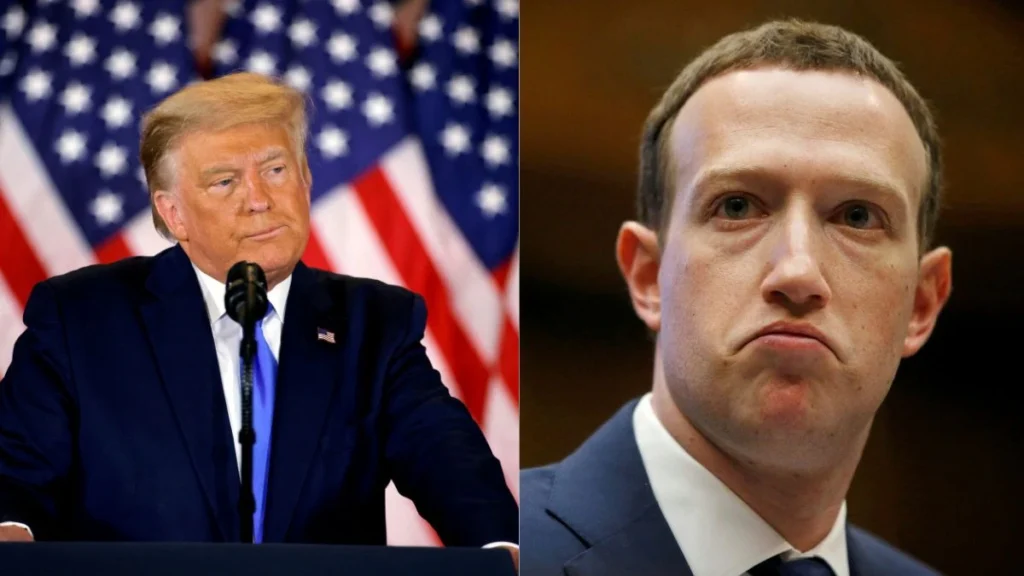
Meta CEO Mark Zuckerberg dined with President-elect Donald Trump at Mar-a-Lago on Wednesday, marking a potential step toward improving relations after a history of disagreements over Facebook’s content moderation policies.
Renewing ties
“It’s an important time for the future of American Innovation,” Meta spokesperson Andy Stone said in a statement to The Verge.
“Mark was grateful for the invitation to join President Trump for dinner and the opportunity to meet with members of his team about the incoming Administration.”
The details of their conversation are unknown, but the meeting suggests that Trump may be softening his stance on Zuckerberg, as the CEO seeks to build a positive relationship with the incoming president.
Stephen Miller, Trump’s incoming deputy chief of staff for policy, told Fox News on Wednesday that Zuckerberg “has been very clear about his desire to be a supporter of and a participant in, this change that we’re seeing all around America,” AFP reported.
“He’s made clear that he wants to support the national renewal of America under President Trump’s leadership,” Miller said in a televised interview.
As Meta executives recognized Trump’s potential for a 2024 election victory, Zuckerberg reportedly spent the past 18 months working to repair their relationship. According to two sources familiar with the talks, the CEO had at least two private phone conversations with Trump over the summer, The New York Times reported.
During one call, Zuckerberg wished Trump well and said he was “praying” for him after the assassination attempt. In a subsequent interview, Zuckerberg praised Trump’s reaction to the incident, calling him a “badass” for pumping his fist to the crowd after the shooting attempt at a Pennsylvania rally.
Zuckerberg, along with other tech CEOs, congratulated Trump on his election win, expressing in a Threads post that he’s “looking forward to working with you and your administration.”
Patchy history
Before the election, Zuckerberg halted election-related philanthropy, and Meta modified its algorithms to limit political content, according to AFP. Previously, Zuckerberg had made significant donations to nonprofits supporting US electoral infrastructure during the COVID-19 pandemic.
These contributions were criticized by Trump after his 2020 loss to Joe Biden, with Trump alleging they were part of a scheme to sway the election.
Also, Facebook was among the social media platforms that banned Trump following the January 6, 2021, attack on the US Capitol.
Zuckerberg’s relationship with Trump and his allies has been fraught with tension, largely due to Facebook’s content moderation policies, which Republicans argue disproportionately favor Democrats.
Trump, who has long claimed Meta unfairly censored him and other conservatives, has repeatedly criticized Zuckerberg, both on social media and during campaign speeches.
Trump even accused Zuckerberg of working against him in the 2020 election in his new book and warned he would “spend the rest of his life in prison” if he did it again. Trump launched the attack in his new coffee table book, “Save America.”
Net worths
Mark Zuckerberg is the fourth richest person in the world, with a net worth of $196.9 billion as of November 28, 2024, according to Forbes estimates. In contrast, Donald Trump has a net worth of $5.6 billion, ranking him as the 583rd richest person in the world.
This story was updated at 9:25 am AST on Thursday.
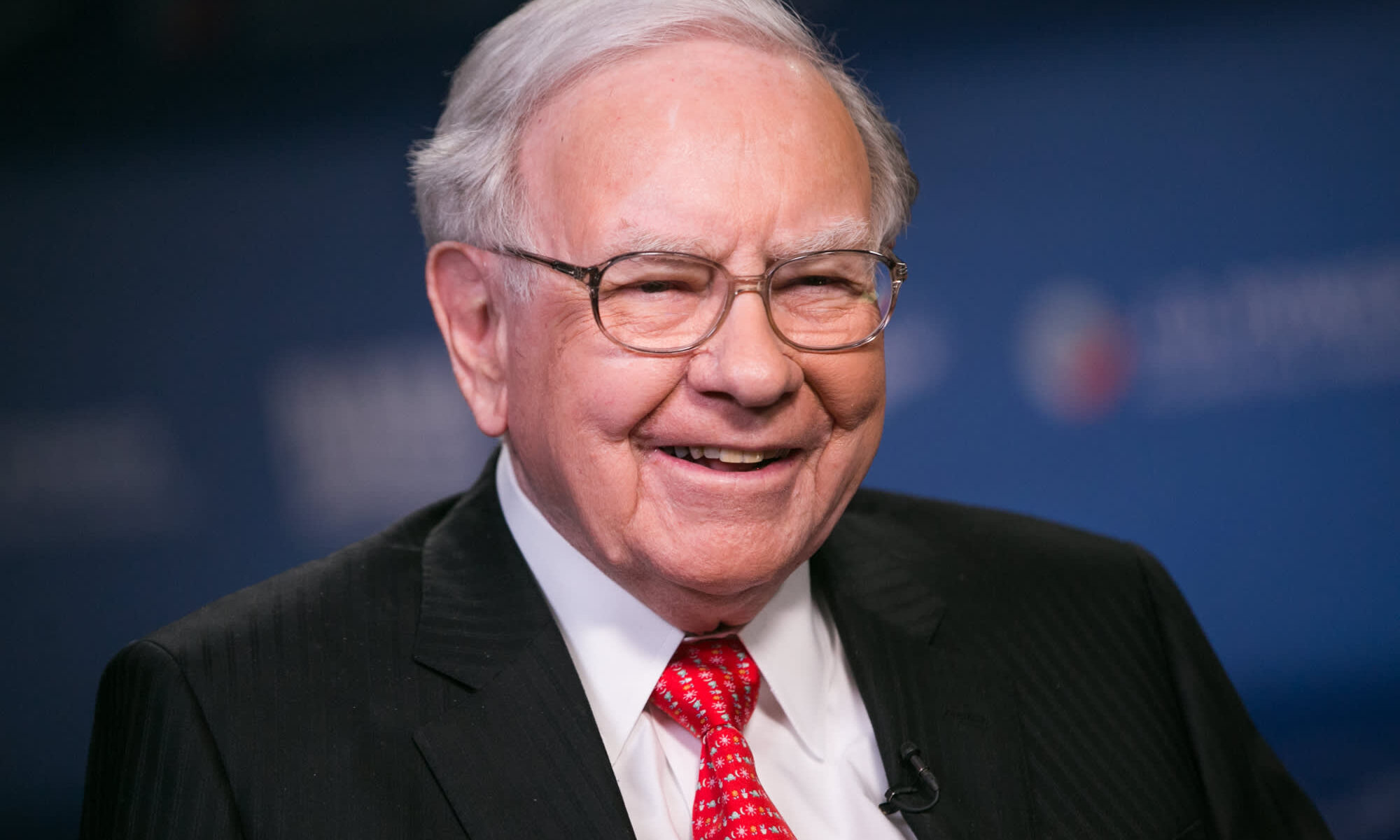
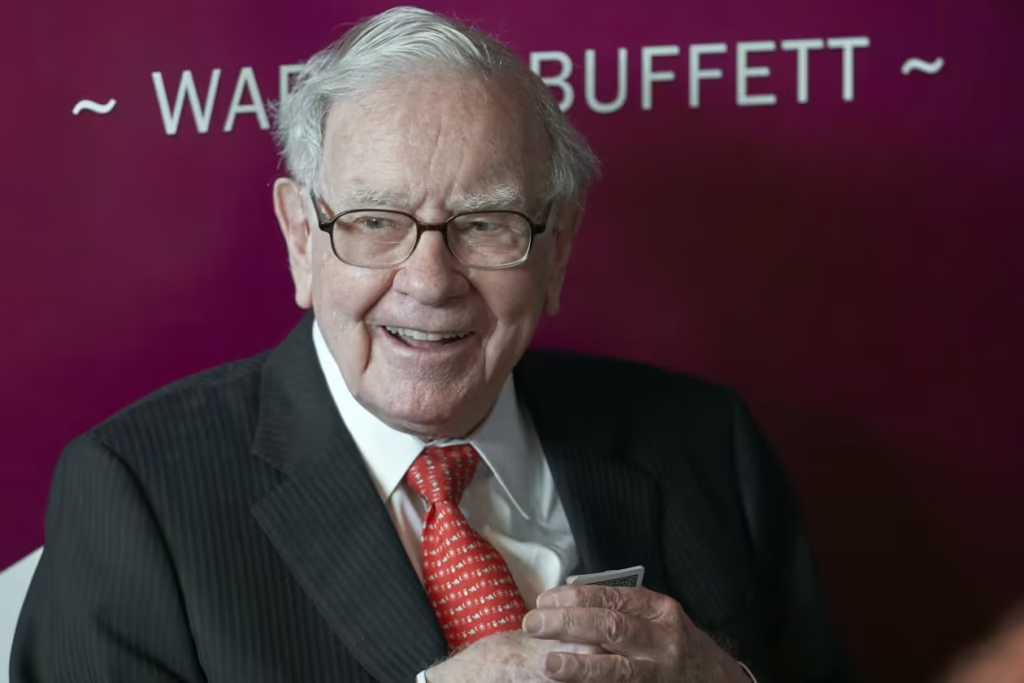
Warren Buffett, the chairman and CEO of Berkshire Hathaway, has donated $5.3 billion worth of Berkshire stock to five charitable organizations, including the Bill & Melinda Gates Foundation and four family charities, marking his largest annual donation since he began his philanthropic campaign in 2006.
Mega donation
The donation comprises approximately 13 million Berkshire Class B shares, including 9.93 million shares allocated to the Gates Foundation, bringing Buffett’s total contributions to the foundation to over $43 billion, according to a statement released on Friday.
Additionally, the Susan Thompson Buffett Foundation, named after his late first wife, received 993,035 shares. Each of his three children’s charities—Howard G. Buffett Foundation, Sherwood Foundation, and NoVo Foundation—was granted 695,122 shares each.
Buffett’s donations have now reached a cumulative total of approximately $55 billion, noted the statement.
In addition to his contributions to the Gates Foundation, his family’s charitable foundations address various causes: the Susan Thompson Buffett Foundation focuses on reproductive health, the Howard G. Buffett Foundation tackles hunger and conflict mitigation, the Sherwood Foundation supports Nebraska nonprofits, and the NoVo Foundation advocates for initiatives benefiting girls and women, according to Reuters.
Buffett, now 93, has committed to giving away more than 99% of his fortune, with his children serving as executors of his will.
His philanthropy is facilitated through Berkshire, an $880 billion conglomerate that includes businesses like the BNSF railroad and Geico car insurance, and stocks such as Apple.
Despite donating more than half of his stock since 2006, Buffett still retains 14.5% of Berkshire’s outstanding shares, according to the statement.
Giving Pledge
Buffett, alongside Bill Gates and Melinda French Gates, also pioneered the Giving Pledge, a campaign encouraging the world’s wealthiest individuals to commit at least half of their fortunes to philanthropic efforts.
The pledge has seen participation from notable figures such as Sam Altman, Michael Bloomberg, Carl Icahn, Elon Musk, and Mark Zuckerberg.
Surprising fact
The recent regulatory filing suggests that Berkshire has made minimal or no stock repurchases since April 19, aligning with Buffett’s preference for deploying capital toward philanthropic causes over share buybacks.
Net worth
Buffett’s real-time net worth stands at $128.4 billion, according to Forbes estimates, making him the world’s 10th richest person.
The grants come at a time of rising homelessness–especially among families.
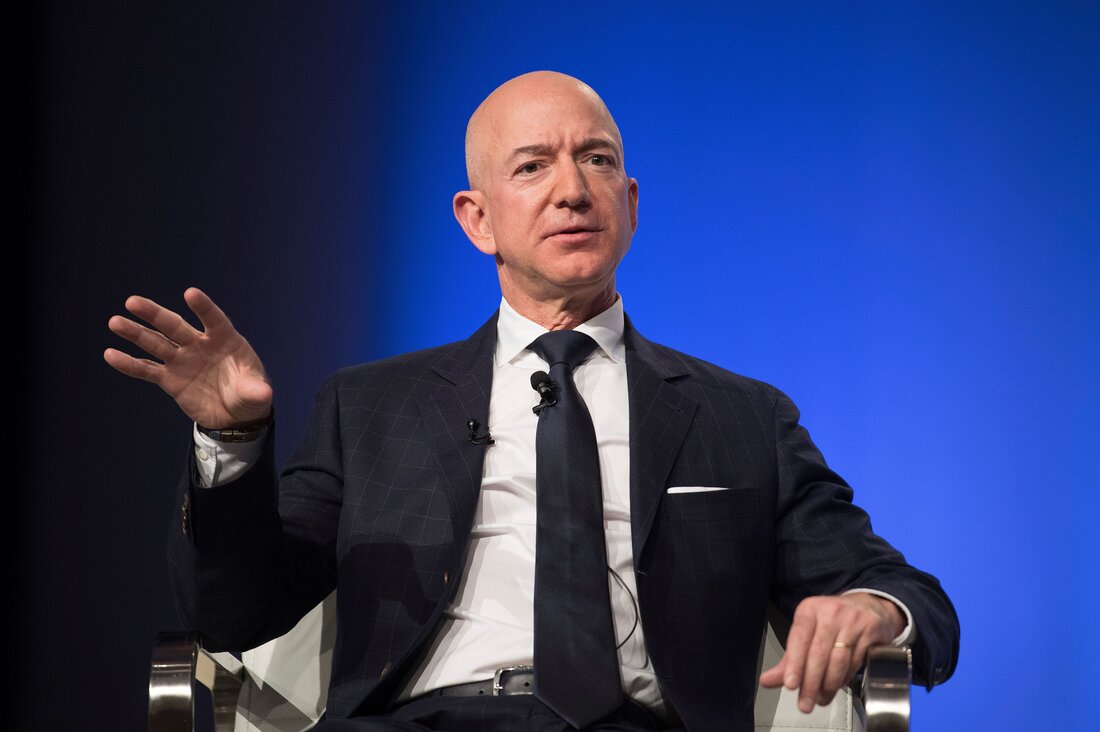
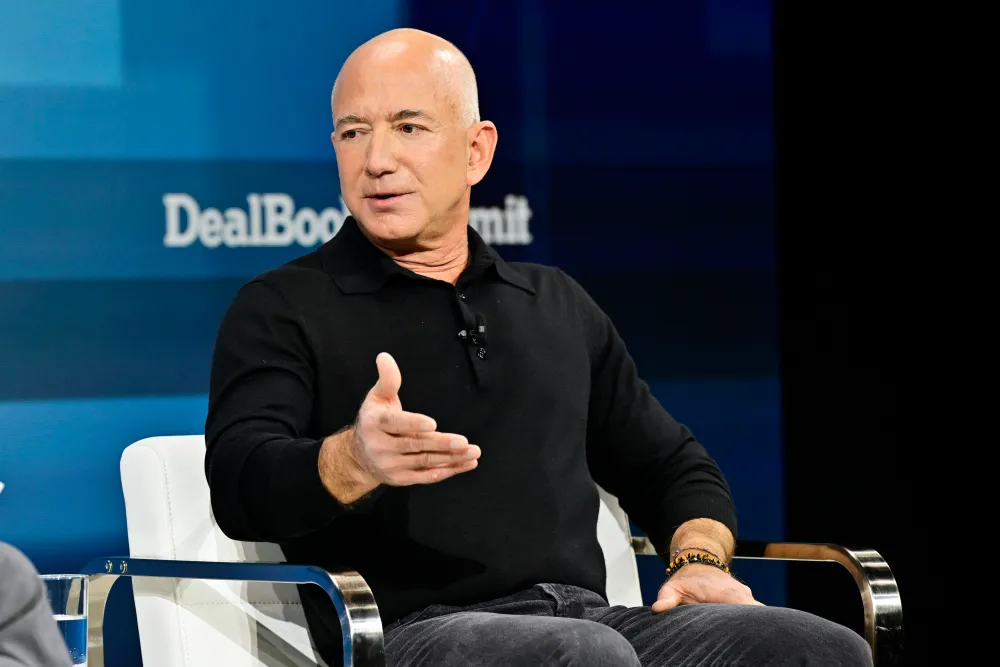
Amazon founder Jeff Bezos, the world’s third-richest person, and his partner Lauren Sánchez announced $110.5 million in new grants to nonprofits working to end homelessness for families from his Day 1 Families Fund, the organization announced on Tuesday.
This round of donations marks the Day 1 Families Fund’s seventh annual round of awards, which range from $425,000 to $5 million and will go to 40 organizations providing services to homeless families in 23 states—including $2.5 million each to the Kentucky-based Welcome House, Los Angeles-based Jenesse Center and a couple of repeat recipients. The Dallas-based Family Gateway group, for example, received a $2.5 million grant this year, after receiving $2.75 million in 2019. Bezos has now granted $749 million of the Day 1 Fund’s $2 billion pledge–made in 2018—to organizations working to help families experiencing homelessness. The new grants bring Bezos’ total estimated giving to $3.5 billion, roughly equal to the amount he got from selling a sliver of his Amazon shares this month (before taxes).
“No child should sleep outside, and it’s a privilege to help in the extraordinary efforts of these organizations,” Bezos, who is richer than ever and worth an estimated $220 billion, wrote in a statement about the new grants. His partner and fiancee Sánchez added that “with homelessness on the rise, there has never been a more important time to support those individuals and organizations making a difference.”
In 2023, more than a million people experienced homelessness in the U.S. for the first time, according to the National Alliance to End Homelessness. Also, the number of unhoused people across the country increased by 12% compared to the previous year, the largest increase since the organization began tracking data in 2007. The rise in homelessness has hit families especially hard: families now represent almost a third of the country’s homeless population. Rising housing costs and a lack of affordable housing, exacerbated by the pandemic and end of the pandemic-era safety net, are to blame, according to the U.S. Interagency Council on Homelessness.
To address the acute issues at hand, the Day 1 Families Fund generally supports organizations that offer emergency or other temporary shelter to specific families. Many of the organizations help those families transition to supportive housing and increase their income so they can then hopefully move to permanent housing.
Ellen Magnis, CEO of Dallas-based Family Gateway, used the nonprofit group’s first Day 1 Families Fund grant in 2019 to help families—often single mothers with hourly-wage jobs who are sick and don’t have sick pay benefits—find short-term alternatives to emergency shelters, which are often full and also expensive to build, like a hotel room. While they are in their temporary housing arrangements, the organization helps families find permanent housing and pays the related up-front fees, like their security deposit and first couple months’ rent. She says that Family Gateway plans to use this year’s grant to meet the “significant increase” in post-pandemic demand.
Michael Goze, CEO of the American Indian Community Development Corporation, a Minneapolis-based nonprofit that purchases and develops affordable apartment complexes for unhoused Native people, received a $5 million grant from the Day 1 Families Fund last year. Goze says they’ve been able to use the funding to expand their efforts and are in the process of buying seven more three-bedroom apartments. AICDC pairs people who live in their apartments—including people escaping domestic violence, a single mother working her way through college and a family whose previous building burned in a fire—with case managers and financial advisors in a five-year program to help them earn more and thus move to stable permanent housing.
“Bezos is giving money to the people on the front line, dealing with the problem on a daily basis, and I don’t know that there is anybody better to understand how to create change than the people that are in the fight,” Goze says.
Still, others think the problem goes beyond helping families find housing and needs to be addressed at its root—increasing wages and lowering rents to prevent homelessness in the first place.
“This is a band-aid on a structural problem, although it’s a very good band-aid until we get the proper legislation to increase wages and tenant protections,” says Omar Ocampo, a researcher at the Institute for Policy Studies, a progressive think tank based in Washington, D.C. Ocampo coauthored a report that blames billionaires and billionaire investors for exacerbating the housing affordability crisis by investing heavily in real estate and using it for high-end development, short-term rentals and as an investment asset, resulting in too many vacant homes with skyrocketing rents. “There’s little incentive for billionaires to construct affordable housing at a scale that would put downward pressure on prices,” says Ocampo.
He recommended donations to community-controlled housing like community land trusts (a common destination for MacKenzie Scott’s grants) that make sure properties can’t be resold for profit, as well as advocacy for legislation around workers’ and tenants’ rights so they can then afford housing without philanthropic assistance.
With a second Trump administration looming, there will likely be less regulation around housing and housing development and fewer taxes on the ultra-wealthy, which can result in billionaires being more philanthropic, Ocampo says. And Bezos, who primarily does his philanthropy through both the Day 1 Fund and his climate-focused Bezos Earth Fund, is not the only billionaire donating to housing and homelessness causes—although it’s far from a favorite cause among billionaires. Perhaps the biggest donor to affordable housing organizations in the country is Bezos’ ex-wife MacKenzie Scott, who has poured nearly $2 billion into those nonprofits, including several community land trusts. In 2019, Salesforce CEO Marc Benioff donated $30 million to research initiatives on homelessness at UC San Francisco and over the last year gave 440 acres of land to an affordable housing developer in Hawaii, where he lives and where its governor declared the housing crisis a state of emergency. And brokerage titan Charles Schwab donated $65 million in 2020 to build supportive housing in San Francisco. Given the demand for affordable housing and the rise in family homelessness, there is appetite for more such philanthropy.
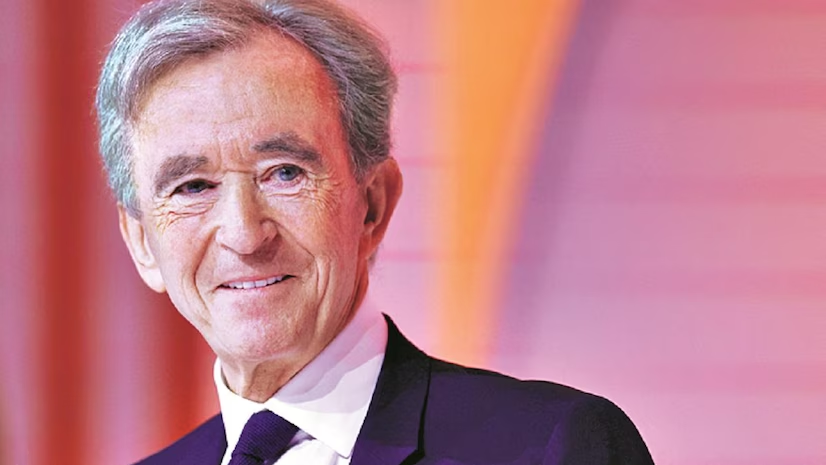
Bernard Arnault, chairman and CEO of LVMH Group, received the Malcolm S. Forbes Lifetime Achievement Award at the Forbes Global CEO Conference 2024 on Wednesday in Bangkok.
The award recognizes a lifetime of achievement and is a celebration of the global business success bestowed upon an individual who embodies and exemplifies the ideals of entrepreneurship championed by the late Malcolm S. Forbes, the legendary publisher of Forbes.
A civil engineer by training, Arnault went on to parlay a small fortune from his family’s construction business in northern France into a multibillion dollar global fashion empire. With a net worth of $156 billion, Arnault is the world’s fifth-richest person, according to Forbes’ real-time data.
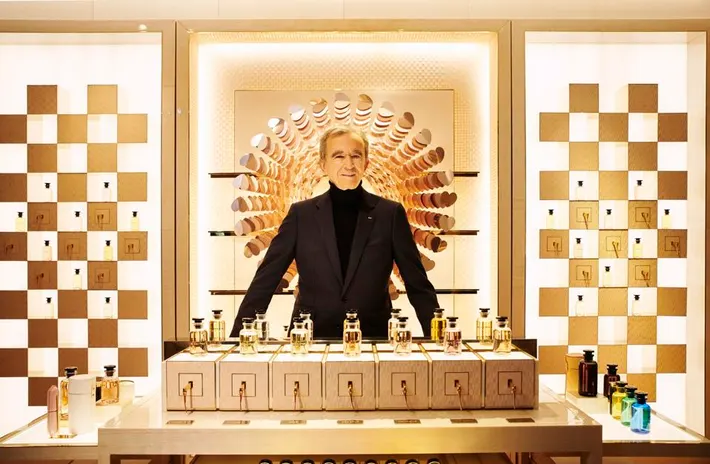
Arnault created LVMH to become the world’s largest luxury conglomerate by market cap ($312 billion) with a portfolio of over 75 luxury brands including flagship Louis Vuitton and Moet Hennessy. The French tycoon got his start with the acquisition of Christian Dior in 1984 and over four decades stitched together a series of deals under LVMH, the largest of which was the $15.8 billion acquisition of American jeweler Tiffany & Co. in 2021.
“There was nothing in his background to suggest he would revolutionize the luxury industry. But great insights and innovations often come from outsiders, who see what others missed,” Steve Forbes, chairman and editor-in-chief of Forbes Media, said as he presented the award to Arnault. “When Bernard Arnault learned Christian Dior, the crown jewel of French luxury, was buried in a family textile conglomerate, he recognized the opportunity that others missed. He saw the foundation of something extraordinary.”
LVMH, which operates over 6,000 stores globally and employs more than 200,000 people, saw net profit rise 8% last year to 14.1 billion euros ($15 billion) on 86.2 billion euros in revenue fueled by strong growth across its business divisions including fragrances and makeup.
“We are not aiming for short term profit growth, we say in the company that profitability is a consequence,” Arnault, 75, said in his acceptance speech. “What we want is to do the most beautiful products of the highest level of quality as possible.”
Arnault first expanded LVMH’s global footprint to China in the 1990s, where increasing spending power translated into exponential sales growth. The region is now the biggest market for the company, accounting for about 34% of group sales in 2023, followed by the U.S. with 26%.
Apart from scaling up LVMH into a global fashion house, Arnault has also been investing in technology companies in recent years. His holding company Agache backs venture capital firm Aglaé Ventures, which has investments in businesses such as Netflix and ByteDance.
Reflecting his belief that active participation of the controlling shareholders’ family in the business provides stability and continuity, Arnault’s five children all work at LVMH.
“An active shareholding family is an incredible asset for a company: it provides stability, continuity in strategic options, constant control in execution, and long-term projection,” Arnault said.
Arnault’s eldest daughter, Delphine, 49, is chairman and CEO of Christian Dior Couture, the group’s second-biggest brand by sales after Louis Vuitton. Antoine, 47, is in charge of image and environment across the group and is also vice chairman and chief executive of holding company Christian Dior SE through which the family controls LVMH.
Earlier in November, Alexandre, 32, was appointed deputy chief executive Moet Hennessy, after spending four years as a senior executive at New York-based Tiffany & Co, where he was credited with refreshing the jewelry brand. Frédéric, 29, heads one of the family’s main holding companies, Financière Agache, which controls LVMH, while Jean, 26, runs watchmaking at Louis Vuitton.
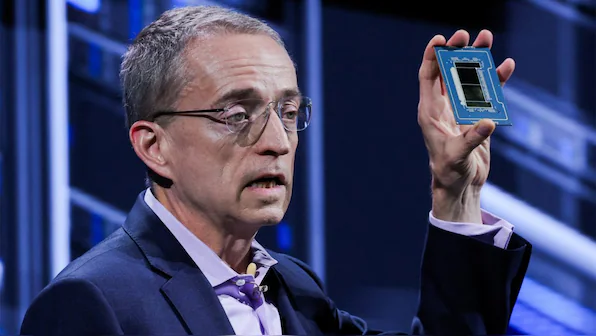
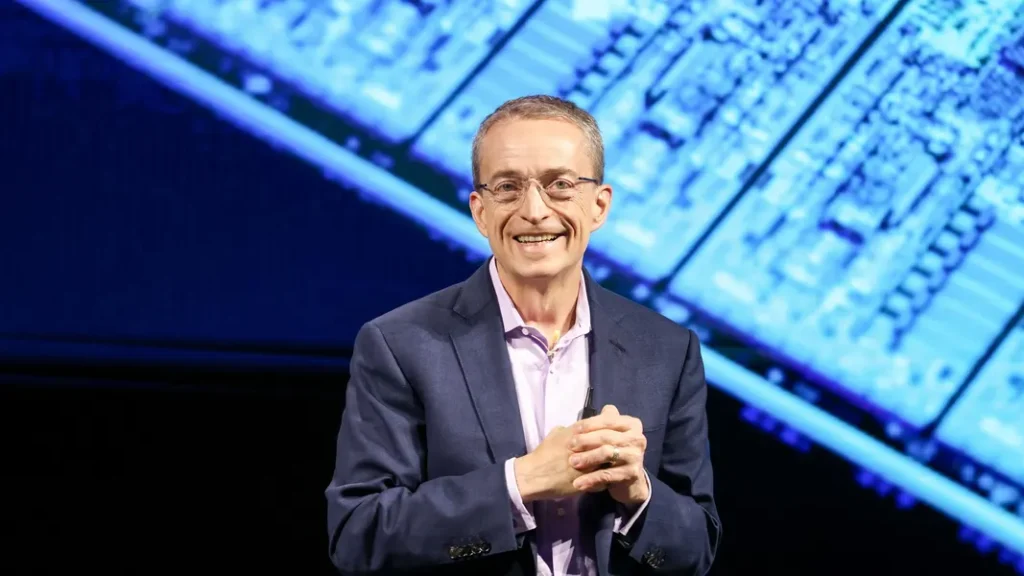
Intel’s chief executive officer retired effective immediately, the legacy Silicon Valley stalwart announced Monday, a shakeup that follows an extended period of stock market underperformance for the semiconductor chipmaker.
Key facts
Intel’s CEO Pat Gelsinger retired effective immediately Sunday.
David Zinsner, the company’s chief financial officer, and Michelle Johnston Holthaus, the chief executive of Intel Products, will lead the company as interim co-CEOs.
The 63-year-old Gelsinger took over as Intel’s top decisionmaker in February 2021.
Shares of Intel rose 4% in premarket trading following the announcement.
Big number
-53%. That’s how much Intel stock returned during Gelsinger’s 3.5-year tenure as the chipmaker’s top executive. The benchmark S&P 500 stock index returned 69% during the timeframe, while fellow American chipmaker Nvidia skyrocketed more than 900%.
Tangent
Intel’s extended stock market struggles notably came during a remarkably strong stretch for its top rivals as capital flowed into the companies powering the artificial intelligence revolution. Over the last decade, Intel is the 16th-worst-performing stock listed on the S&P, returning -16%, according to FactSet data. Meanwhile, Intel’s most notable competitors Nvidia and Advanced Micro Devices are by far the top-performing major American companies, as Nvidia exploded by nearly 28,000% and AMD 5,000%, according to FactSet data.
Key background
Analysts project Intel to report its first annual loss since 1986 this year. It’s been a remarkably underwhelming stretch for the chipmaker, which suffered its worst day on Wall Street in 50 years this summer when it suspended its dividend and announced a 15% workforce reduction. The rut comes despite an $8 billion grant from the Biden Administration’s CHIPS Act and intense interest in semiconductor chips amid the generative AI boom, with much of Intel’s struggles traced back to its relatively underwhelming perception in the AI space.
Chief critic
“At the end of the day, you need leading edge products, innovation, and execution; none of which we saw during Pat Gelsinger’s reign,” wrote Rosenblatt analyst Hans Mosesmann in a Monday note to clients.
From philanthropist Melinda French Gates to Mexican president Claudia Sheinbaum, the world’s 100 most powerful women command a collective $33 trillion in economic power and influence more than 1 billion people.
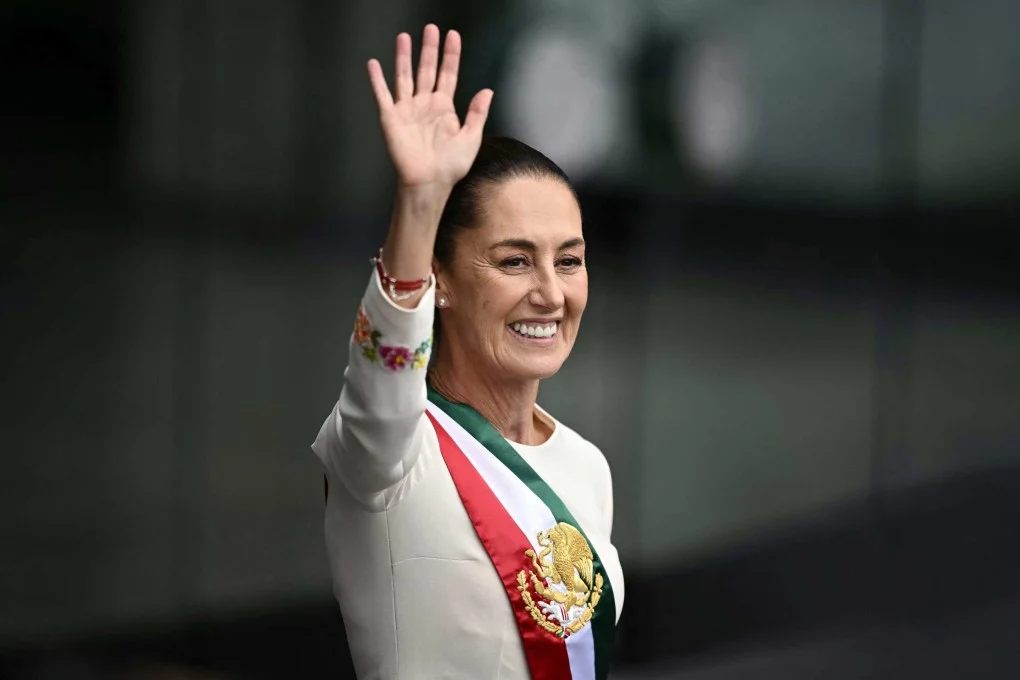
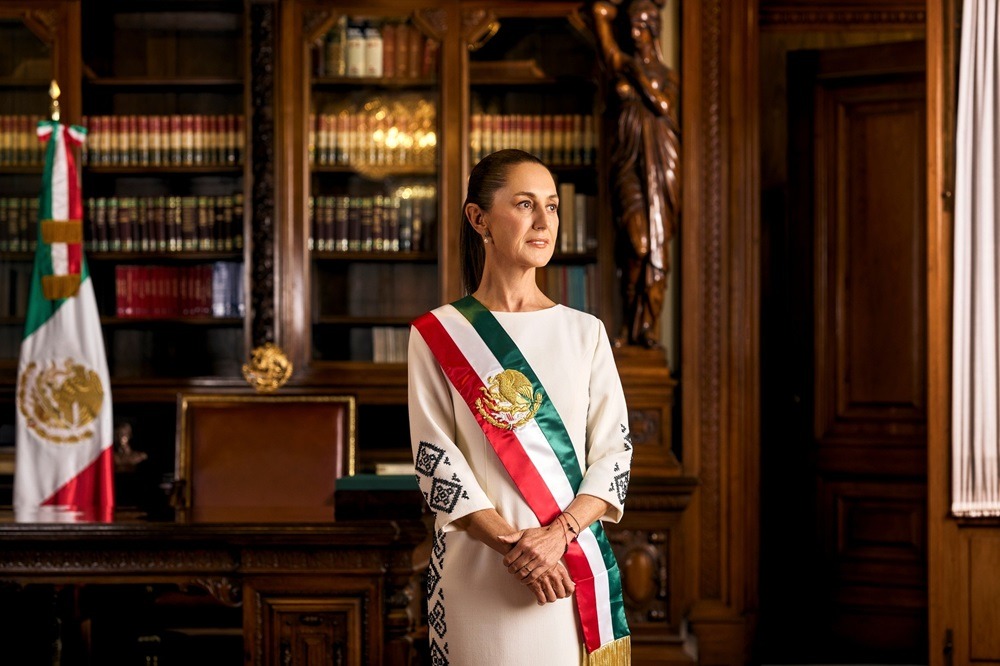
After Claudia Sheinbaum took the oath of office as Mexico’s president in October, a historic cheer filled the congressional chamber: “Presidenta! Presidenta!”
Sheinbaum, 62, is the first woman to preside over the nation—the world’s 12th-largest economy—in its 200 year history as an independent country. “Many of us were told a version of history since we were children, which wanted us to believe that the course of humanity was led only by men. But little by little this vision has been reversed,” she said in her inauguration speech. “It is time for women.”
Much of the world is not getting this message. While Sheinbaum debuts on the Forbes list of the World’s 100 Most Powerful Women at No. 4, several would-be peers have fallen from the list’s ranks over the year: U.S. Vice President Kamala Harris, once No. 3, lost her bid for the American presidency and is, for now, on her way out of power. Taiwan president Tsai Ing-wen (formerly No. 30) left office in May, while now-former Slovakian president Zuzana Čaputová (previously No. 84) left office in June after deciding not to run for a second term.
Meanwhile, the Reykjavík Index—a comprehensive survey of G-7 countries—finds that public confidence in female leadership across business and politics is declining. “The support of female leadership is not going to happen just because we presumed history would make the world more equal,” says Michelle Harrison, founder of the index. “Women are experiencing a series of regressive forces that make their ability to achieve and retain power harder, not easier.”
Many of the women on the 2024 Power Women list are, for the meantime, defying these trends: In May, Malina Ngai took over as Group CEO of AS Watson—the world’s largest international health and beauty retailer—and makes her Power Women list debut at No. 75. Melinda French Gates has pledged $1 billion over the next two years to advance women’s power globally; she moves to No. 8, up two spots. For the way she galvanized the world’s attention on women’s sports this year, Caitlin Clark occupies the No. 100 spot.
The 2024 Power List was determined by four main metrics: money, media, impact and spheres of influence. For political leaders, we weighed gross domestic products and populations; for corporate chiefs, revenues, valuations and employee counts were critical. Media mentions and social reach were analyzed for all.
The result: 100 women who command a collective $33 trillion in economic power and influence—by policy or by example—more than 1 billion people. Their leadership across finance, technology, media and beyond stands as a potent retort to those who question a woman’s ability to wield power.
Or, as Nobel Peace Laureate and former Liberian president Ellen Johnson Sirleaf told a Forbesaudience in March: “Women deserve the equity and equal opportunity because they’ve already earned it. They’ve earned it through knowledge, through education, through example, through what they are.”
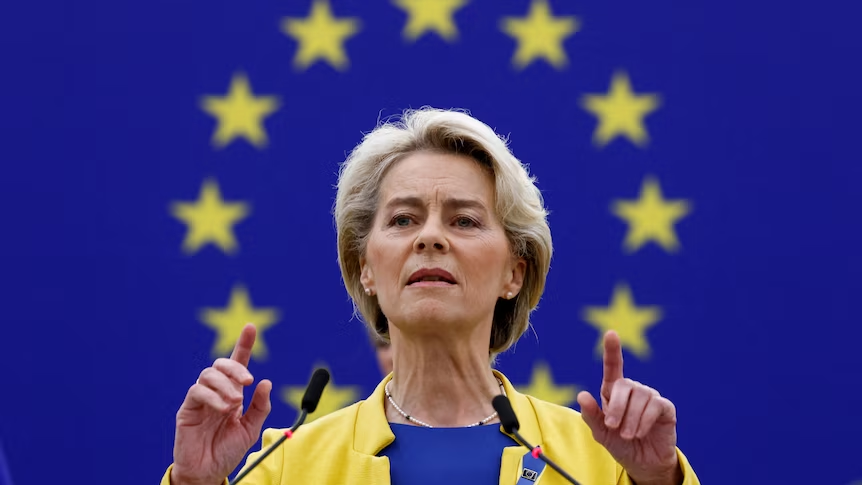
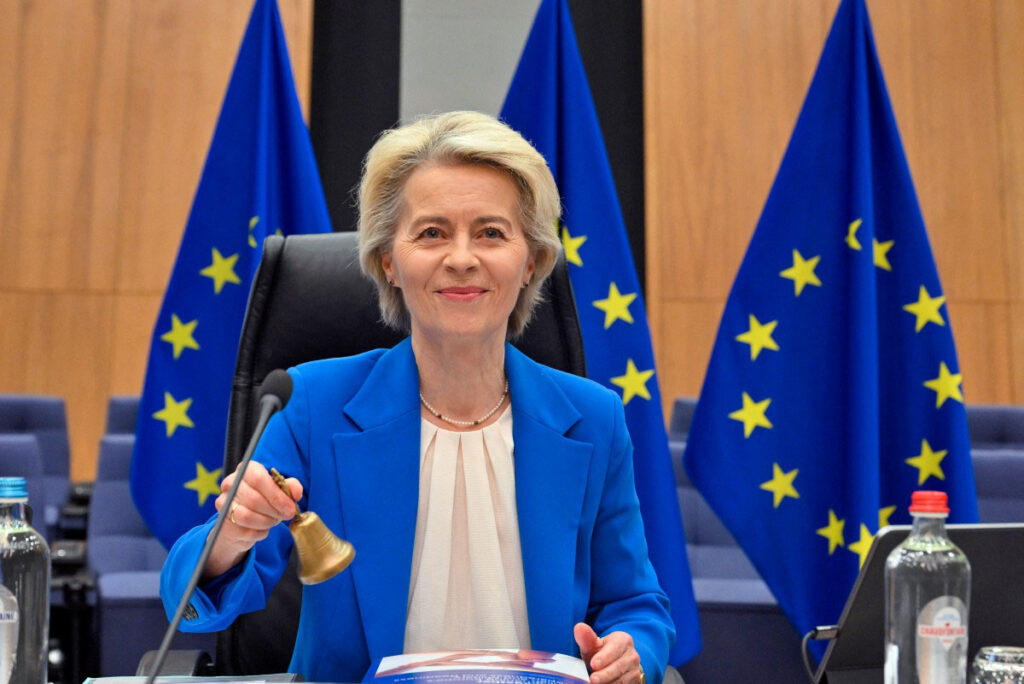
President of the European Commission Ursula Von der Leyen rings a bell to start the first meeting of the new College of Commissioners of the European Union in Brussels on December 4, 2024.
From Ursula von der Leyen to Taylor Swift, these 100 women are wielding power in new ways.
As economic uncertainty and geopolitical tensions reshape the global order in 2024, a critical question emerges: Is women’s power advancing or retreating? Look at the highest reaches of power – they remain stubbornly male-dominated. Three of the world’s four largest economies have never been helmed by a woman. Kamala Harris, whose rise to Vice President signaled progress, met a decisive defeat in her bid for the presidency. Silicon Valley’s five largest companies have yet to appoint a woman CEO, while on Wall Street, only Citigroup’s Jane Fraser leads a major bank. Overall, women lead just 8% of S&P 500 companies, suggesting that decades of momentum have only yielded incremental gains.
Yet focusing solely on these metrics misses a profound shift that Forbes’ 2024 list of the World’s 100 Most Powerful Women reveals: while the established hierarchies remain resistant to change, women are increasingly controlling the critical intersections where industries transform. From AI infrastructure to market systems to policy frameworks, their decisions ripple across multiple sectors and societies. Their influence flows not from traditional authority but from strategic positions at the nexus of change, revealing a new and potentially more consequential kind of power.
This power dynamic is clear at the summit of global influence. European Commission President Ursula von der Leyen (No. 1) and European Central Bank President Christine Lagarde (No. 2) together shape the destiny of the EU’s $18 trillion economy, their decisions determining everything from AI regulation to climate policy. Italy’s Giorgia Meloni (No. 3) steers the EU’s third-largest economy through a significant transition, while Mexico’s Claudia Sheinbaum (No. 4), the nation’s first female president, leads the world’s 15th-largest economy at a moment of regional transformation.
Nowhere is this shift more evident than in the architecture of our AI future. Lisa Su (No. 26) transformed AMD from an industry afterthought into a crucial force in artificial intelligence, with its stock surging nearly 50-fold during her 10-year tenure. At Oracle, Safra Catz (No. 17) has engineered one of technology’s most dramatic cloud transformations. Even more striking, a remarkable concentration of female CFOs—including Colette Kress (No. 55) at Nvidia (now worth $3 trillion), Amy Hood (No. 23) at Microsoft, and Susan Li (No. 41) at Meta—are building global AI infrastructure as these companies reshape every industry. Ruth Porat’s (No. 12) elevation to president and Chief Investment Officer at Alphabet signals how the CFO role has become a crucial pathway to broader influence in tech’s most influential companies.
Perhaps most striking is how influence can emerge from unexpected quarters. At just 22, basketball phenomenon Caitlin Clark (No. 100) demonstrates how rapidly the rules of power can change. By consistently outdrawing men’s championships and shattering WNBA viewership records before her first professional game, she’s forcing entire industries to rewrite their assumptions about market value and economic potential. Her impact reaches beyond sports into media rights, advertising, and cultural expectations.
This pattern of transformation extends across sectors. As President and COO of SpaceX, Gwynne Shotwell (No. 25) has built the company into a $210 billion force in commercial space, trusted by NASA, the U.S. military, and the European Space Agency for their most critical missions. Taylor Swift (No. 23) isn’t merely breaking touring records with her billion-dollar Eras tour – she’s rewriting music industry economics, spurring federal antitrust scrutiny of Ticketmaster, and reshaping how artists approach ownership and touring. In streaming, Netflix Chief Content Officer Bela Bajaria (No. 62) and Amazon MGM Studios head Jennifer Salke (No. 65) not only control the algorithms and data that determine what billions watch, but which voices and stories shape global culture.
This clustering of female influence extends powerfully into global finance and policy. Women increasingly shape market infrastructure – Adena Friedman (No. 46) at NASDAQ, Lynn Martin (No. 47) at NYSE, and Bonnie Chan (No. 61) at Hong Kong Exchange are reimagining capital flows in an increasingly digital economy. In economic policy, a powerful cohort has emerged: Rachel Reeves (No. 39) as UK Chancellor, India’s Finance Minister Nirmala Sitharaman (No. 28), Australian Reserve Bank governor Michele Bullock (No. 45) and Indonesia’s Finance Minister Sri Mulyani Indrawati (No. 49), each steering major economies through rapid transformation. The financial sector’s evolution continues as Helen Wong makes history as the first female CEO of Singapore’s OCBC, while Priscilla Almodovar (#38) becomes the only Latina leading an S&P 500 company as Fannie Mae’s CEO.
While some traditional power centers see setbacks – like Karen Lynch’s departure from CVS’s top spot (No. 6 in 2023) – women are gaining ground in sectors increasingly central to global transformation. Janet Truncale’s (No. 44) breakthrough as EY’s first female chief executive signals this shift, as consulting firms become a crucial force in how industries navigate technological and regulatory change.
What emerges is a sophisticated new map of influence. This year’s Power Women oversee $33 trillion in GDP and influence the lives of more than 1 billion people, but their true impact flows from their positions at crucial intersections where industries and systems transform. While the established corridors of power remain resistant to change, women’s influence has never been more profound or far reaching. These leaders prove that in a world where transformation is the currency of influence, women aren’t just participating in change, they’re architecting it. And by this measure, women’s collective power is on the rise.
Mike Federle
CEO
Mike Federle is the Chief Executive Officer of Forbes, one of the world’s most instantly recognizable brands and one of the largest media companies by audience. Under Mike’s direction, Forbes continues to expand its product portfolio and its reach. Forbes, which is synonymous with “success” in almost every country around the world, engages 150 million people across every platform every month – the most in its 104-year history. Since he was appointed to CEO in December 2017, Mike has successfully completed Forbes’ digital transformation efforts and led the company to four of its most successful years on record. He works closely with his management team and employees at all levels to set corporate strategy and nurture a #OneTeam culture that fosters innovation and allows the brand to quickly pivot in a rapidly changing marketplace. Today, Forbes delivers the most-diverse audiences of any business media brand – entrepreneurs, the C-suite (CMOs, CEOs, CFOs, CIOs), small-business owners and more – through a robust product portfolio that includes the industry-leading BrandVoice, Insights, ForbesWomen, LIVE and Forbes Virtual platforms, as well as highly recognizable global franchises, including Under 30, Over 50, Philanthropy, Forbes 400 and more. Under Mike’s direction, the company also has undertaken an aggressive and highly successful licensing strategy that includes 47 licensed local editions in 80 countries, as well as brand extensions in education, financial services and more. Forbes has also embarked on a strategic M&A strategy that extends the brand into new areas and is differentiated in the marketplace. The combination of Mike’s vision, execution and employee empowerment skills make him a widely respected thought leader on a range of subjects such as the intersection of tech and media, digital transformation/change management, corporate culture, and emerging technologies (AI, Blockchain, automation). In addition to serving as CEO, Mike serves as a Director on the Forbes Media, LLC Board of Directors. Mike previously served as the company’s President and Chief Operating Officer. Prior to joining Forbes in 2011, he was a Co-Founder, President and Chief Operating Officer of Techonomy Media Inc, a multimedia company based in New York, in which Forbes acquired an equity interest in July 2011. Techonomy was sold in 2018 to Clarim Holdings, a private holding company established by Jim McCann, founder of 1-800-Flowers. With 30+ years’ experience in the media business, he has successfully guided multiple companies through the constantly evolving industry. He has held top positions at Publisher of Fortune magazine, Group Publisher of the Time Inc. Business & Finance Network that included media properties such as Fortune, Money, Business2.0 and CNNMoney.